
Basketball Dribble Aid

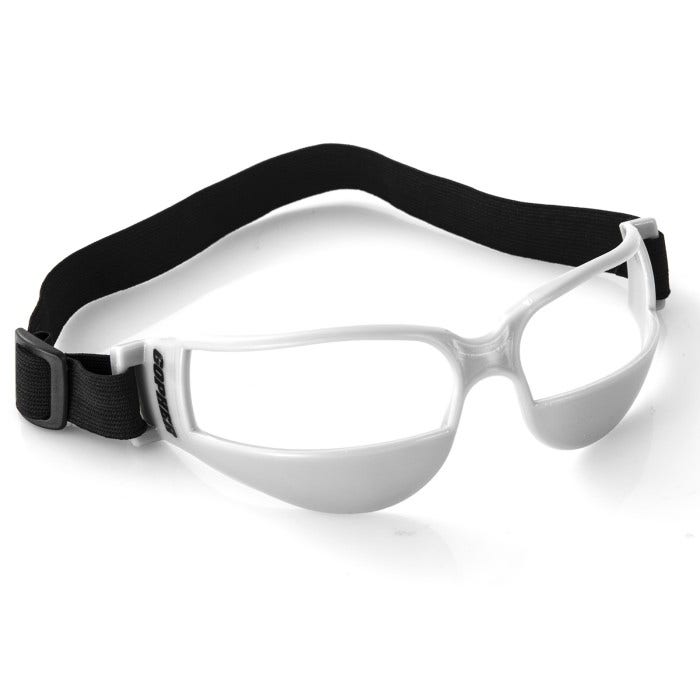
Dribbling aid prevents player from looking down at the basketball.
In Stock
Item# 60-197
Ea


These basketball dribbling glasses feature a lens that's obstructs the user's view looking down, making it difficult for students to see the ball while they dribble. This design forces the player to keep his/her head up and they learn to rely on touch and feel when dribbling. Over time, this motion becomes second nature, so players stay focused on what is in front of them (avoiding a defender or setting up for a shot).

Thanks to an elastic head strap, these are a one-size-fits-all solution that will fit any student. Soft plastic cups are also comfortable over the eyes and on the face.


15 Fundamental Movement Skill Activities Using the Basketball Dribble Aid 

The Basketball Dribble Aid is designed to train players to dribble with their heads up by blocking downward vision and forcing users to rely on feel, spatial awareness, and peripheral sight. Unlike basic blinders, this adjustable tool promotes proper form while developing control, confidence, and court awareness. It’s an ideal tool for physical education classes that focus on building manipulative and body control movement skills. The following 15 activities creatively use the Dribble Aid to enhance ball-handling, agility, coordination, and decision-making in dynamic, inclusive ways.

1. Blind Bounce Basics: Students wear the Dribble Aid while practicing stationary dribbles with both hands. Teaches hand control and touch sensitivity.

2. Tunnel Vision Tag: Taggers wear the Dribble Aid while dribbling and chasing others. Emphasizes awareness, dodging, and ball control under limited vision.

3. Shadow Shuffle: In pairs, one student leads movements while dribbling and the partner mirrors—all while wearing the Dribble Aid. Builds coordination and mimicry under pressure.

4. Cone Crawl Crossover: Students maneuver through a cone course using crossover dribbles, wearing the Dribble Aid. Encourages body control and focused footwork.

5. Partner Pass Pursuit: One student dribbles wearing the Dribble Aid while a partner jogs beside them, calling out where to pass. Builds trust, communication, and passing while focused on movement.

6. Up Top Pop Shot: After dribbling across the court with the Dribble Aid, students shoot at a goal. Combines dribbling under constraints with shooting accuracy.

7. Tempo Tap Challenge: Play music with variable tempos. Students dribble in rhythm while wearing the Dribble Aid, adjusting speed and intensity. Teaches rhythm and timing control.

8. Partner Cone Dash: One student calls directions (left/right/stop) while the other wears the Dribble Aid and dribbles to each cone. Reinforces auditory response and spatial trust.

9. Crossover Chaos: Students must dribble and switch hands every 3 bounces while navigating a zigzag path. Sharpens crossover dribbling without visual reference.

10. Turn & Burn Drills: Students perform a quick 90° or 180° turn while maintaining dribble. Promotes turning and agility in combination with ball handling.

11. Relay with a View: Students dribble in a relay while calling out landmarks or objects posted on walls. Trains multitasking with visual scanning.

12. Pacer Push Drill: Students perform slow-to-fast-to-slow dribble progressions over a set distance. Encourages controlled acceleration and deceleration.

13. Beat the Bounce: In this game, students try to bounce and catch the ball before it hits a line—but only by using feel. Develops bounce judgment and hand-eye timing.

14. Follow-the-Leader Dribble Train: Students form a line and follow a leader’s path while dribbling, all wearing Dribble Aid. Builds timing, formation movement, and spatial adjustment.

15. The Ultimate Dribble Duel: Pairs compete to see who can dribble the longest while navigating challenges (cones, balance beams, turns), all while wearing the Dribble Aid. Combines endurance, balance, and precision.